How hard is it to buy business insurance online? We tested 6 platforms for a 15-person tech company (2026)
For a 15-person California software company seeking general liability and cyber at $1 million limits, the only option to see pricing indications without filling out full applications is Komodo, and another platform tried to upsell a package nearly 9x the price of Komodo's.
 by Athena Cao 12 min read
Key takeaways
- Which platforms quoted exactly what we asked for? Komodo quoted the general liability and cyber we requested after asking 12 questions. Vouch quoted both after 70 questions, but defaulted to a much bigger package. Others didn’t give the option for exactly what we asked.
- Which platform asked the most questions? Embroker asked 78 questions but didn't give us the option to buy just cyber and general liability; cyber had to be bundled with tech E&O on Embroker, but not every policyholder needs both together.
- What happened on other platforms? CoverWallet declined after one question and referred us to Tivly. Tivly showed no prices online and said an agent would call.
- What matters beyond price? Who issues the policy, whether every coverage you asked for is on the quote, and whether pricing and options are presented transparently.
About these results: We ran each test in October 2026 for one company profile. Carriers change their appetite and preferred classes of business over time, and pricing moves with them. Treat these findings as a snapshot of what buying insurance can involve on a given day.
What company did we test, and what coverage did it need?
We applied as a California software developer with 15 employees, $2 million in annual revenue and no prior claims. We requested two coverages, each at a $1 million limit: general liability and cyber. This is a minimal purchase for a company of this size and class.
- General liability: covers third-party bodily injury and property damage claims, and is the coverage most often required by leases and customer contracts.
- Cyber: covers both the insured's own costs and third-party costs of cyber accidents, including data breaches, cyberattacks and others depending on the policy coverage. See our guide to cyber insurance for small businesses.
How did we run the test?
One tester completed every application, starting from each platform's homepage. The timer started on arrival and stopped at the first screen showing a price. Every field answered before that point, including dropdowns, counted as one question. Where a platform showed several prices from the same carrier, we counted one carrier and noted the number of options. We bound no coverage.
How did the six platforms compare?
Only Komodo quoted exactly the general liability and cyber we requested. Vouch quoted both after 70 questions, with larger packages highlighted. Embroker sold cyber only with tech E&O, a coverage we had not requested, and took 78 questions to reach a price. Simply Business quoted general liability from one carrier and offered no cyber. CoverWallet declined after one question, and Tivly showed no prices online.
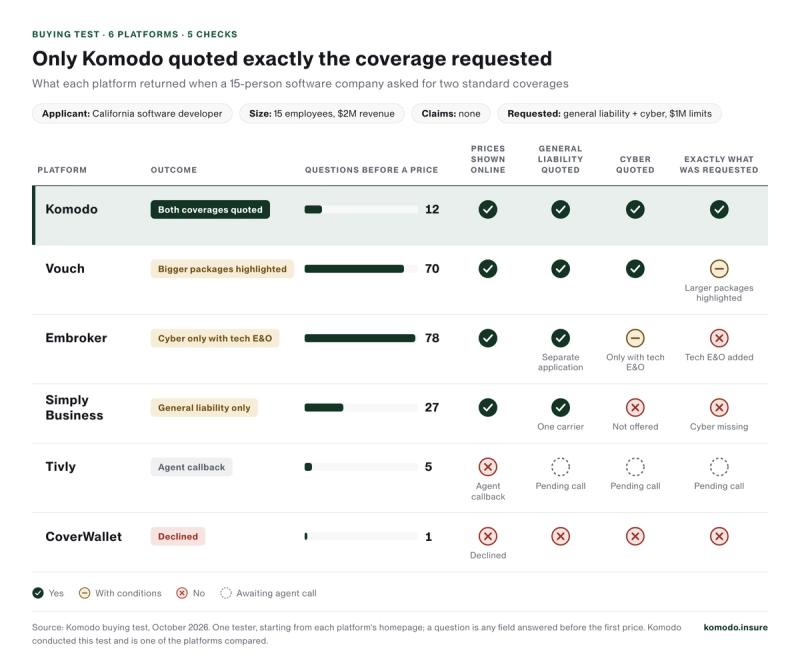
Source: Komodo buying test, October 2026. Komodo conducted this test and is one of the platforms compared.
Chart in words: Komodo passed every check. Vouch showed prices after 70 questions and quoted both coverages, with larger packages highlighted. Embroker showed prices after 78 questions with cyber bundled into tech E&O. Simply Business showed general liability prices after 27 questions and no cyber. Tivly asked 5 questions and showed no prices. CoverWallet declined after 1 question.
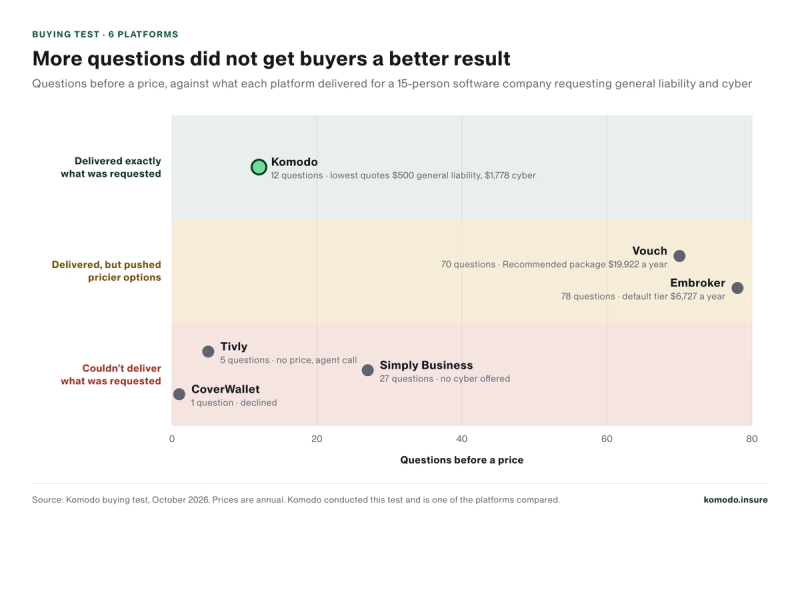
Source: Komodo buying test, October 2026. Prices are annual. Komodo conducted this test and is one of the platforms compared.
Chart in words: Komodo asked 12 questions and delivered exactly the general liability and cyber requested, with lowest quotes of $500 and $1,778 a year. Vouch (70 questions) and Embroker (78) delivered, but pushed pricier options. Simply Business (27 questions), Tivly (5) and CoverWallet (1) asked fewer questions but could not deliver what was requested.
What happened on each platform?
Each platform handled the same request differently. One quoted exactly the coverages requested, one quoted them alongside larger recommended packages, one sold cyber only inside a larger bundle, one quoted general liability alone, one declined, and one moved the buyer to a phone call. The details below show where each process added cost, time or risk for the buyer.
Komodo
Komodo asked 12 questions before showing prices for both coverages. The lowest general liability quote was $500 a year, and the lowest cyber quote was $1,778 a year. The whole process took 8 minutes, with quotes from 5 carriers rated between A- and A++ by AM Best.
“We built Komodo to give policyholders exactly what they need, no more and no less. Every option for their holistic coverage needs is on the table, and the choice to add anything additional is theirs to make.”
Vouch
Vouch required an account registration after 11 questions. The verification code arrived in our junk folder, a small delay that could stop a buyer who does not think to look there. Vouch then offered to connect to the company’s Carta account to prefill information; we declined.
Reaching prices took 70 questions and 20 minutes, with most pages presenting one question only (so we had to click a lot of Next!). Several questions went beyond the coverages we requested. Vouch asked for balance sheet details and the name of our lead investor, information typically used to underwrite directors and officers (D&O) coverage, which we had not asked for.
Vouch returned three packages. The first, labelled Requested Coverage, included general liability and cyber for $409.88 a month, about $4,919 a year.
The package highlighted as Recommended cost $1,660.19 a month, about $19,922 a year, four times the requested coverage. It added business personal property, errors and omissions, media liability and D&O. A third package, Growth Coverage, added employment practices and fiduciary liability for $2,622.17 a month, about $31,466 a year. The screen did not name the carriers behind any package.
Embroker
Embroker offered cyber only bundled with tech E&O, a coverage we had not requested, and we could not find the option to decline it. Reaching prices took 78 questions and about 15 minutes. The most expensive tier was selected by default, the general liability application had to be found separately, and the issuing carrier was shown for the general liability coverage but we could not find the carrier for tech E&O and cyber.
- Bundled cyber. Cyber came only with tech E&O, so a company that needs only cyber pays for a second coverage it did not request, and we could not find the option to decline it. If you are weighing that second coverage, see what technology E&O insurance covers.
- Two applications. We selected both general liability and tech E&O at the start, yet the application moved straight to a tech E&O quote and stopped there. We had to locate the general liability application ourselves. A buyer who missed this step could leave believing general liability was included.
- Default tier. The total for general liability, tech E&O and cyber came to $5,127 or $6,727 a year, depending on the tier. General liability was $590 a year in both tiers, $239 less than equivalent coverage from Coterie through Simply Business. The Elite tier, selected by default, priced tech E&O and cyber at $6,137, for a total of $6,727. The Premier tier, displayed less prominently, priced the same pair at $4,537, for a total of $5,127. A buyer who accepts the default pays $1,600 more a year.
- Unnamed carrier for tech E&O and cyber. Embroker named the issuing carrier for general liability, but we could not find the carrier for tech E&O and cyber, or how many carriers it approached. Without the carrier's name, a buyer cannot check its financial strength rating before deciding.
Each step pointed toward a larger purchase: cyber came only with tech E&O, the most expensive tier was preselected, and general liability sat in a separate application.
Simply Business
Simply Business returned general liability pricing after 27 questions and 5 minutes 14 seconds. All three options came from one carrier, Coterie (AM Best A- / A), starting at $749 a year for a $1 million limit. Cyber was unavailable, so a company needing both coverages would have to buy cyber elsewhere.
Some questions are difficult to answer with confidence. One asks whether "any of the following questions" are true, then combines prior claims, pending claims and "circumstances that may give rise to a claim" into a single yes or no. An inaccurate answer on an application can affect coverage later, so wording like this matters more than it appears.
CoverWallet
CoverWallet asked one question, identified the applicant as a technology company, and declined to quote either coverage. It referred us to Tivly instead.
Tivly
Tivly asked five questions, displayed no prices online and stated that an agent would call.
What should buyers look for beyond price and speed?
Price and time to quote are the easiest things to compare, and eight other factors decide whether a business ends up properly insured. Our test surfaced each one: real quote counts, default selections, questions beyond your request, missing coverages, the issuing carrier, application accuracy, declines and like-for-like comparison. The questions below explain what to check for each.
Does a platform's carrier count tell you how many quotes you will get?
A platform's carrier count describes its full panel. The number of quotes a particular business sees can be far smaller. Simply Business advertises 18 carriers; for our 15-person software company, one carrier quote was presented. The reliable measure is how many carriers actually return a price for your profile.
Is the default quote on an insurance platform the best option?
Check every tier before you accept a default. Embroker preselected its most expensive tier for tech E&O and cyber, at $6,137 a year. A lower tier at $4,537 was available and displayed less prominently. Buyers who accept the default can pay substantially more for a choice they never actively made.
Why does an insurance platform ask about coverages you did not request?
Some platforms underwrite every line they sell, regardless of what the buyer selected, so they can recommend a larger package. Vouch asked about our balance sheet and lead investor, questions used for D&O coverage, although we requested only general liability and cyber. Its recommended package then cost four times the coverage we asked for. Buyers should compare the package that matches their stated needs, not the one a platform highlights.
How do you know your insurance application is complete?
Confirm that every coverage you requested appears on the final quote before you pay. We selected general liability and tech E&O on Embroker, and the application ended after the tech E&O quote with no sign that general liability was still outstanding. A buyer could finish believing a risk was covered when it was left uninsured.
Why does it matter which insurance carrier issues your policy?
The carrier is the company that pays your claims, so its financial strength determines whether the policy holds up when you need it. AM Best ratings are the standard measure: an independent opinion of an insurer's ability to meet its ongoing policy obligations. Embroker named the carrier for general liability, but we could not find the carrier behind its tech E&O and cyber quote, leaving no way to check that rating first.
What happens if you answer an insurance application question incorrectly?
An inaccurate answer can give the carrier grounds to deny a claim or rescind the policy, because the application forms part of the insurance contract. In California, concealment "whether intentional or unintentional" entitles the insurer to rescind. Clear wording matters: Simply Business folded prior claims, pending claims and potential claims into one yes-or-no question.
Our guide to cyber insurance application questions walks through the security questions carriers ask and how to answer them accurately.
What happens when an insurance platform declines your business?
You may be referred elsewhere, sometimes into a different kind of process. CoverWallet declined our tech company after one question and referred us to Tivly, which showed no prices online and required a phone call with an agent. A buyer can move from a self-service platform to an agent-led process without choosing to.
Can you compare insurance quotes across platforms?
Only when the coverages, limits and deductibles match. Embroker sold cyber only bundled with tech E&O, so its price covered a different set of coverages from the other platforms. Before comparing prices, confirm that each quote insures the same risks on the same terms. For a side-by-side view of platforms, see our comparison of small business insurance platforms.
Frequently asked questions
Can a tech company buy cyber insurance without tech E&O?
Yes. Many carriers write cyber coverage without tech E&O. In our test, Embroker offered cyber only bundled with tech E&O, a coverage we had not requested, and we could not find the option to decline it on that platform.
Why do some insurance platforms decline tech companies?
Each carrier and platform sets an appetite: the industries, sizes and risks it chooses to insure. Platforms built around very small businesses may decline technology companies entirely, as CoverWallet did in our test after one question. A decline from one platform says little about the wider market, so try a platform that works with several carriers.
How many questions does it take to get a business insurance quote?
In our test, platforms that returned prices asked between 12 and 78 questions. Simply Business asked 27 for general liability alone, and Embroker asked 78 across two applications. The number depends on the coverages requested and how each platform structures its application, with cyber usually adding security questions.
Which insurance platforms quote general liability and cyber together for a tech company?
In our test of six platforms, Komodo and Vouch quoted both general liability and cyber for a 15-person California software company; Vouch also highlighted larger packages. Embroker quoted cyber only bundled with tech E&O, Simply Business quoted general liability only, Tivly required an agent call and CoverWallet declined. Results can change as carriers adjust their appetite.
Is the default tier on Embroker the cheapest option?
In our test, Embroker preselected its Elite tier, pricing tech E&O and cyber at $6,137 a year. The Premier tier priced the same pair at $4,537 and was displayed less prominently. With general liability at $590, a buyer who accepted the default paid $6,727 a year, $1,600 more than the Premier total of $5,127.
Methodology and disclosures
Tests were conducted in October 2026. Equivalent general liability coverage means the same limits, $1 million per occurrence and $2 million in the aggregate, and the same deductible. Every platform quoted general liability at these limits. Prices are annual premiums before taxes and fees as displayed at the time of testing.
Athena Cao is the founder of Komodo, a digital commercial insurance agency for small businesses.
Komodo conducted this test and is one of the platforms compared. Komodo provides educational information and, where authorized, insurance brokerage services. Coverage availability, pricing and terms are subject to eligibility, underwriting and carrier approval.
Sources and further reading
- Komodo buying test of six insurance platforms, October 2026
- Simply Business, simplybusiness.com (carrier count), checked October 8, 2026
- AM Best, Guide to Best's Financial Strength Ratings
- California Insurance Code section 331 (concealment)
- California Insurance Code section 359 (false representation)
Related guides
This guide is general educational information, not legal, tax, or insurance advice. Coverage depends on your business, the insurer's underwriting and the issued policy terms.