Are Business Insurance Rates Going Down?
Yes. Average US commercial insurance premiums fell 2.0% in Q2 2026, the steepest quarterly drop since 2017, according to The Council of Insurance Agents & Brokers (CIAB). That ended 33 straight quarters of increases. Insurers hold surplus capital and are competing for customers, so late 2026 is the best time in nine years to shop before you renew.
 by Athena Cao 6 min read
Key takeaways
- Is now a good time to buy business insurance? Yes. Late 2026 is the best buyer's market since 2017.
- How much are prices falling? Average US commercial premiums fell 2.0% in Q2 2026, and ten lines of coverage got cheaper (CIAB).
- What is falling fastest? Commercial property (-6.3%), cyber (-3.2%) and workers' compensation (-3.2%).
- What should a business do? Get competing quotes 60 to 90 days before renewal. Renewal premiums are still rising on average, so the savings go to buyers who shop. In the past weeks, dozens of Komodo customers have obtained lower prices for equivalent or better coverage.
Is this the best time in a decade to shop for business insurance?
Late 2026 is the best time to buy business insurance since 2017. At the 2020 peak, average premiums were rising more than 10% a year; in Q2 2026 the same CIAB survey shows them falling 2.0%. Only 2016 and early 2017 were softer, so anyone who first bought coverage after 2017 is seeing average prices fall for the first time.
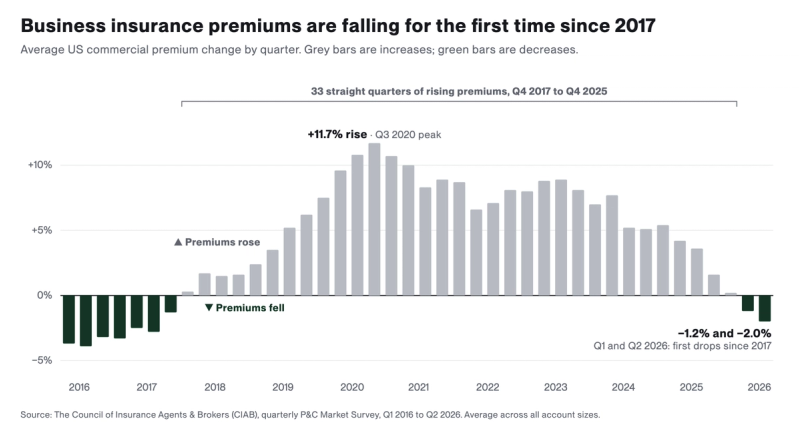
Source: The Council of Insurance Agents & Brokers, quarterly P&C Market Survey · Q1 2016 to Q2 2026 · average premium change across all account sizes
Chart in words: CIAB's average commercial premium change was -3.9% in Q2 2016, turned positive in Q4 2017, peaked at +11.7% in Q3 2020, stayed above +5% through 2024, slowed to +0.2% in Q4 2025 and reached -2.0% in Q2 2026.
What are the key numbers for the 2026 commercial insurance market?
| What was measured | Latest figure | Period | Source |
|---|---|---|---|
| Average US commercial premium change, all account sizes | -2.0% | Q2 2026 | CIAB P&C Market Survey |
| Small account premium change | -0.5% (was +1.1% in Q1) | Q2 2026 | CIAB P&C Market Survey |
| Reinsurance price reductions reported by insurers | About 15% to 20% | 2025 renewals | BCG |
What is a soft insurance market?
A soft insurance market is the side of the insurance market cycle marked by low rates, high limits, flexible contracts and wide availability of coverage (IRMI). A hard market is the upswing of the cycle, when premiums increase, coverage terms are restricted and capacity for most types of insurance decreases (IRMI).
US commercial insurance was in a hard market from late 2017 through 2025, with average premiums rising for 33 consecutive quarters in CIAB's survey and peaking at +11.7% in Q3 2020. (CIAB)
Why are business insurance rates falling?
Rates are falling because insurers hold surplus capital after a highly profitable 2025, and they are competing for customers to put it to work. Marsh attributes the decline to strong insurer results, surplus capital, lower reinsurance costs and higher investment returns.
- Insurers nearly tripled their underwriting profit. The US property/casualty industry recorded a $60.9 billion net underwriting gain in 2025, up from $22.1 billion in 2024. (AM Best)
- Those profits are attracting more capacity. Swiss Re Institute reports an 89% combined ratio for Q3 2025, the lowest quarterly level since at least 2001, and says attractive margins are drawing more capacity into the sector and easing prices. (Swiss Re Institute)
- Their capital is at historic highs. BCG reports that industry surplus, the capital insurers hold to pay claims, is at historically high levels. (BCG)
- Reinsurance got cheaper. Reinsurance is the insurance that insurers buy. Insurers reported price reductions of about 15% to 20% at 2025 renewals, according to BCG.
- Rates are falling across product lines. Marsh reports strong insurer competition in all major product lines, with every global region recording a composite rate decrease in Q2 2026. (Marsh)
Coverage terms are improving too: Marsh reports that insurers are competing on broader coverage, expanded policy terms and lower deductibles.
Which business insurance coverages are getting cheaper, and which are not?
Commercial property (-6.3%), cyber (-3.2%) and workers' compensation (-3.2%) got cheaper in Q2 2026, while commercial auto (+4.5%) and umbrella liability (+5.3%) kept rising, according to CIAB. The soft market is real but uneven, so how much a business saves depends on which coverages it buys.
| Coverage | 2026 Trend | Latest figure | Source |
|---|---|---|---|
| Commercial property | -6.3% average premium, Q2 2026 | CIAB | |
| Cyber | -3.2% average premium, Q2 2026; global rates down twelve straight quarters | CIAB, Marsh | |
| Workers' compensation | -3.2% average premium, Q2 2026 | CIAB | |
| Employment practices liability | Premiums decreased, Q2 2026 | CIAB | |
| Directors and officers (D&O) | Premiums decreased, Q2 2026 | CIAB | |
| General liability | +4.18% average renewal change, August 2026, down from 4.99% in July | Ivans Index | |
| Business owner's policy (BOP) | +5.44% average renewal change, August 2026, down from 5.94% in July | Ivans Index | |
| Commercial auto | +4.5% average premium, Q2 2026 | CIAB | |
| Umbrella liability | +5.3% average premium, Q2 2026; 35th straight quarterly increase | CIAB |
Falling Increases slowing Rising
For an office-based company with 5 to 100 employees, the coverages that usually make up most of the bill (cyber, workers' compensation, property within a BOP, and employment practices liability) sit on the falling side of this table. Companies with vehicle fleets or large umbrella limits will see less relief. For what each of these coverages does, see our guide to business insurance basics.
If the market is soft, why did my renewal go up?
Renewals are priced from last year's premium, so a softer market reaches a renewing policy slowly. The Ivans Index, which tracks renewal premiums across more than 38,000 agencies and 700 carriers and MGAs, shows the average business owner's policy renewing 5.44% higher in August 2026 and general liability 4.18% higher. New quotes are priced against today's competition.
Over the same period, brokers told CIAB that small-account premiums were falling and that carriers were competing for clients. The two measures are built differently, and renewal premiums also rise when your payroll, revenue or property values grow.
The lower prices in a soft market go to businesses that request competing quotes. Komodo's own results point the same way: in the past weeks, dozens of Komodo customers have obtained lower prices for equivalent or better coverage.
“2026 is a once-in-a-decade reshuffle, and Komodo is built to deliver business insurance buyers the most transparent and efficient experience.”
How do I shop my business insurance in a soft market?
Start 60 to 90 days before your renewal date, gather your payroll, revenue and loss history, and get at least two quotes for the same limits, deductibles and exclusions. Compare coverage as well as price, then take the best competing quote back to your current insurer before you decide.
- Find your renewal date and current premium. Both are on your policy declarations page.
- Gather the facts insurers price on. Payroll, annual revenue, headcount, office locations and your loss history for the last three to five years. Our business insurance quote checklist lists each item and why it matters.
- Get more than one quote for the same coverage. Match limits, deductibles and exclusions so the prices are comparable. See how commercial insurance quotes work for what goes into each quote.
Data is current through Q2 2026 for CIAB and Marsh, and through August 2026 for the Ivans Index. This article is updated when each quarterly survey is published.
This article is general information, not insurance advice. Market averages do not predict the price of any individual policy.
Sources and further reading
- The Council of Insurance Agents & Brokers, Q2 2026 P&C Market Survey, August 18, 2026
- The Council of Insurance Agents & Brokers, P&C Market Survey archive, Q1 2016 to Q2 2026
- Marsh, Global Insurance Market Index, Q2 2026, July 23, 2026
- Swiss Re Institute, US Property & Casualty Outlook: soft market, or soft landing?, January 20, 2026
- Boston Consulting Group, The 2026 Insurance Value Creators Report: Softer Rates and Bigger Risks Are Reshaping the US P&C Market, June 25, 2026
- PKF Littlejohn, Navigating the soft market, June 4, 2026
- Ivans, Ivans Index August 2026 Results, September 9, 2026
- AM Best, First Look: 2025 US Property/Casualty Financial Results, March 23, 2026
- International Risk Management Institute (IRMI), Soft Market definition
- International Risk Management Institute (IRMI), Hard Market definition
Related guides
This guide is general educational information, not legal, tax, or insurance advice. Coverage depends on your business, the insurer's underwriting and the issued policy terms.